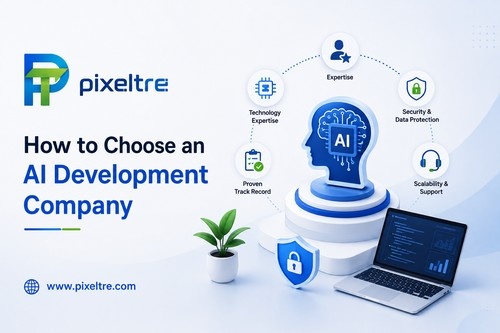
AI projects fail for many reasons, but rarely because the technology didn't work. They fail because the wrong partner was chosen: teams that over-promise, under-deliver, or build demos that never reach production. Whether you're automating customer support, building a custom AI agent, or adding ML to your product, this 10-point checklist will help you separate capable AI development companies from impressive-sounding ones.
1. Do They Start With Your Problem, Not Their Technology?
A red flag: a company that talks about "LLMs," "RAG," and "fine-tuning" in the first five minutes without asking a single question about *your* business.
A good partner starts by asking:
- What problem are you really trying to solve?
- Which process is costing you the most time or money?
- Who will use this, and what does success look like in measurable terms?
If they can't explain your problem back to you, they don't understand it yet.
2. Do They Have Real, Verifiable AI Experience?
AI is crowded with consultancies that rebranded overnight. Look for:
- Case studies with named or anonymized clients that are specific — not vague logos.
- Production deployments, not just proofs of concept. Ask: "What's the most complex AI system you've actually shipped and run?"
- Proof of engineering depth. Ask which models, frameworks, and infrastructure they use and why.
Beware of companies whose only "AI work" is wrapping ChatGPT in a demo.
3. Do They Tell You What AI Should NOT Do?
This is the most underrated test. A mature partner will sometimes say: "You don't need AI for this a simple workflow or a standard tool will do it better and cheaper."
Teams that sell AI for everything are selling you a solution in search of a problem. Trust the ones who push back.
4. Are They Clear About Data, Security, and Compliance?
AI runs on your data, which means data handling is non-negotiable:
- Where will data be stored and processed?
- Will your data be used to train public models? (It shouldn't be, without your consent.)
- Can they work within your compliance needs — GDPR, DPDP Act, HIPAA, industry norms?
They should raise these questions before you do. If you have to ask every security question yourself, walk away.
5. Do They Show a Realistic Timeline and Budget?
Two things should make you suspicious:
- "It will take 2 weeks!" — for anything non-trivial, that's a lie.
- "It's very hard to estimate." — that's an excuse to bill by the hour forever.
A credible company gives you:
- A phased roadmap (discovery → pilot → production).
- A milestone-based budget with real numbers.
- Clear assumptions about what's included and what would change the scope.
6. Do They Keep a Human in the Loop?
Responsible AI development includes human oversight:
- Where and when does the system act autonomously?
- What's the escalation path when confidence is low?
- How do humans review and correct the system's decisions?
A partner who answers "it handles everything automatically, don't worry" is not engineering responsibly.
7. Do They Measure Outcomes, Not Just Outputs?
Ask how they'll measure success. Good answers:
- "First-response time down from 6 hours to instant."
- "30% of support tickets resolved without a human."
- "Lead follow-up completion up from 40% to 95%."
Vague answers like "it will be smarter" or "the AI will learn" are not metrics. If they can't define how you'll know it's working, treat the proposal as incomplete.
8. Can They Integrate With What You Already Use?
Your AI won't live in a vacuum. It must connect to your CRM, website, WhatsApp, accounting software, and databases.
Ask:
- Which tools and APIs do they typically integrate with?
- Do they understand the stack you already run?
- Ask to see a past integration similar to yours.
The fanciest AI in the world is useless if it can't reach your actual systems.
9. Do They Follow Up With Maintenance and Support?
AI systems drift. Models change, data changes, and inputs change. A real partner offers:
- Post-launch monitoring and retraining.
- A service-level agreement (SLA) for uptime and fixes.
- A roadmap for continuous improvement, not a handover on day one.
If the relationship ends the moment the invoice is paid, you're acquiring a liability, not a capability.
10. Do You Trust Your Gut After Meeting Them?
After everything above — do the people feel like genuine partners? Practical heuristics:
- Do they answer questions directly, or deflect with jargon?
- Do they admit uncertainty honestly?
- Do they sound like they'd tell you the truth even when it costs them the sale?
Long-term AI work requires trust and honesty. No checklist replaces that.
How to Use This Checklist
Don't just read it — use it:
1. Shortlist 3–5 companies based on case studies and relevant experience.
2. Send each the same structured brief describing your problem.
3. Score their responses against these 10 points.
4. Ask for a paid, small pilot on a real slice of your problem before committing to a full build.
A small paid pilot is the cheapest insurance you can buy. It reveals everything a pitch deck hides.
When You Should NOT Hire an AI Company
Before you start searching, rule out these cases:
- You don't yet know which process to automate. Spend time defining the problem before hiring.
- You expect a magic button. AI deployment requires your team's participation, data cleanup, and scope decisions.
- You have no budget for iteration. AI needs a few rounds of tuning anyone promising perfection on the first attempt is not being honest.
The Bottom Line
Choosing an AI development company is a decision about trust and process, not hype and buzzwords. The right partner asks hard questions, sets honest expectations, keeps your data safe, and proves value in a pilot before scaling. Use this checklist at the start of your search, and you'll avoid the two most expensive outcomes: an overpriced demo and a project that never reaches your business at all. Still comparing providers? Send your shortlist the same structured brief and ask for a paid pilot on a small slice of your real problem. That single step will quickly separate serious AI development teams from everyone else.